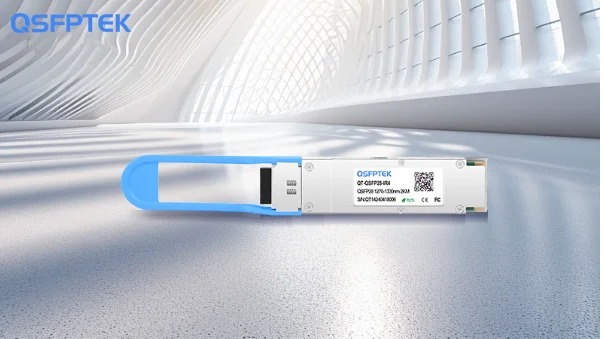
100G IR4: Designed for Data Center Interconnects You Actually Deploy
In real-world data centers, optical design decisions are rarely driven by theoretical maximums. Instead, they are shaped by fiber routes that are longer than expected, patch panels added over time, and the need to balance performance, cost, and operational simplicity. This is where 100G IR4 stands out—not as a marketing headline optic, but as a practical solution for the data center interconnects engineers actually deploy.
The Reality of Short Data Center Links
On paper, many data center interconnects appear to be short-reach. In practice, links between buildings, halls, or campuses often stretch well beyond a few hundred meters. Once fiber routing, slack loops, cross-connects, and patch panels are accounted for, a link originally designed for 500 meters can approach or exceed one kilometer.
This gap between design assumptions and physical reality is precisely where 100G IR4, with its 2 km reach over single-mode fiber, becomes relevant. It provides meaningful reach margin without pushing into long-haul complexity or cost.
Why IR4 Is More Than Longer DR
Compared to 100G DR optics, IR4 offers significantly higher link budget headroom. That margin is not about distance alone, it translates into better tolerance for insertion loss, connector aging, and future reconfiguration. In operational environments where fiber paths evolve over time, this stability reduces the risk of marginal links and unplanned outages.
At the same time, IR4 avoids the overdesign often associated with LR4 or ER4 modules. For most intra-campus and inter-building data center connections, 10 km or 40 km reach provides little practical benefit while increasing optics cost and power consumption.
Designed for How Data Centers Grow
Data centers rarely remain static. New racks are added, routes are re-patched, and redundancy paths are introduced. 100G IR4 aligns well with this incremental growth model. Its four-lane WDM architecture offers a familiar operational profile, while its moderate power consumption fits comfortably within high-density switch platforms.
Importantly, IR4 enables direct switch-to-switch or router-to-router connections without requiring amplification, transponders, or specialized optical systems. This simplicity reduces deployment time and lowers the operational burden on network teams.
Cost and Operational Efficiency in Practice
From a cost perspective, IR4 occupies a balanced position. While it is more expensive than DR optics, it often eliminates the need for expensive fiber rework or strict link engineering. In many deployments, the cost of troubleshooting marginal DR links, or upgrading cabling, quickly outweighs the price difference of the optics themselves.
Operationally, IR4 benefits from standard single-mode fiber and widely supported interfaces, making it suitable for multi-vendor environments. This flexibility is particularly valuable in enterprise and colocation data centers, where interoperability and lifecycle management matter as much as raw performance.
Where 100G IR4 Makes the Most Sense
100G IR4 is ideally suited for intra-campus DCI links, building-to-building connections, and extended leaf–spine architectures that exceed traditional short-reach limits. It is not intended to replace long-haul or coherent solutions, nor is it optimized for ultra-short server connections.
Conclusion
100G IR4 is designed for the data center interconnects engineers actually deploy—links that are short in theory, but demanding in practice. By offering the right balance of reach, margin, cost, and operational simplicity, IR4 fills a critical role between short-reach optics and long-haul solutions, making it a practical choice for modern, evolving data center networks.